
Pickett County Release Route
Pickett County does not offer the usual path of opening a sheriff roster and choosing a recent-release tab. Current Tennessee Department of Correction jail summaries identify Pickett as closed. No official current roster, release archive, 24-hour list, 72-hour list, or sheriff app was found. The Pickett County Sheriff's Office remains the correct first call because it can identify the disposition of local custody and the agency that physically held a Pickett detainee.
Ask a precise question. Was the person released to the community, bonded out, sent to another county, committed to TDOC, or delivered to another agency on a detainer? The answer identifies the next custodian. The holding jail's gate or release log proves when its custody ended. A Pickett court order explains the legal authority. A TDOC or federal record applies only if the custody path reached that system.
The official jail-report page below supports the closed designation. It does not show that Pickett makes no arrests or holds no historical records.
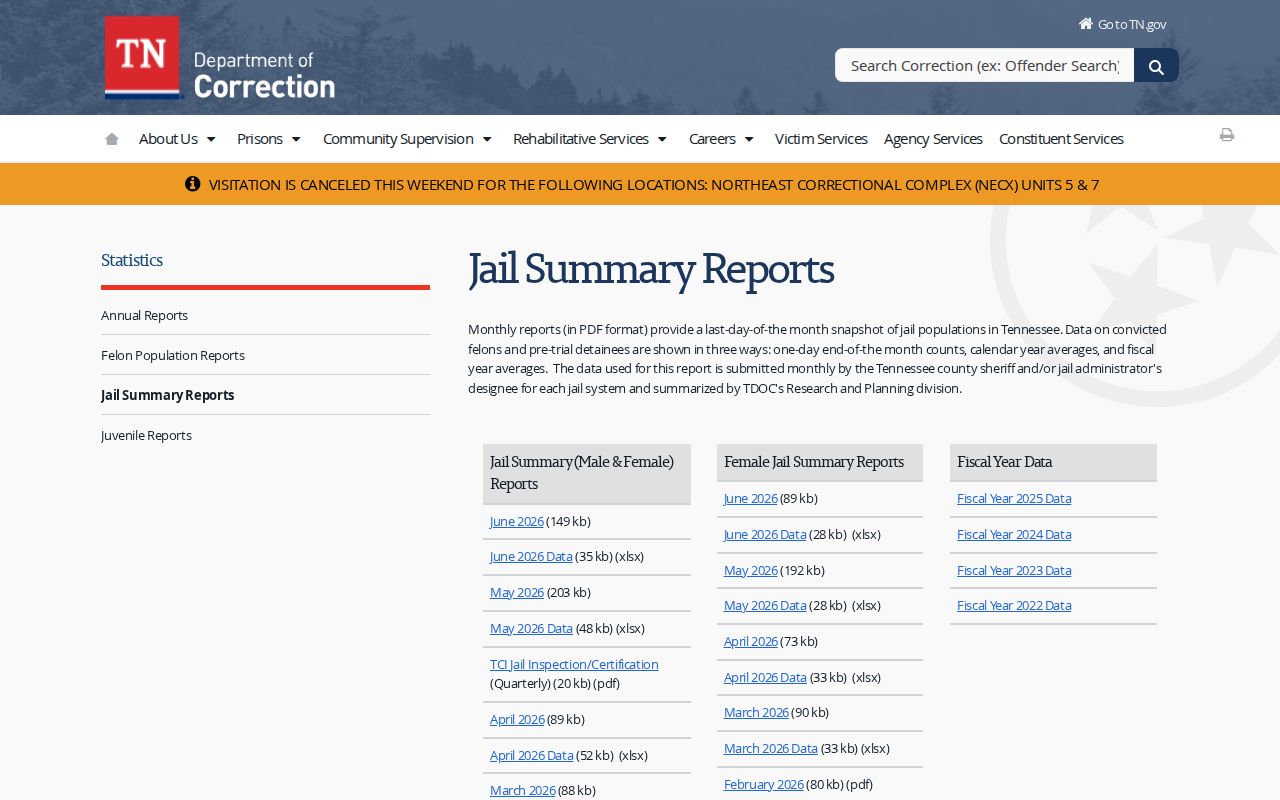
The report source is why an old commercial jail listing should not be treated as a current Pickett County inmate roster.
Pickett County Release Types
A release transaction should answer when one agency ended custody, why that custody ended, and where the person went. Those three facts must be read together. A court may authorize release before staff finish processing. A parole grant can occur while a release plan is still pending. A name can also leave one roster because the person was transferred.
- Bond or recognizance
- The local custodian ends confinement under court-set terms. Check the holding jail release entry and Pickett bond order.
- Time served or sentence end
- The imposed local term has been satisfied. Compare the gate log with the judgment, sentence, and jail-credit record.
- Probation transition
- Custody may end while court supervision begins. Pair the release entry with the probation order.
- County-to-county transfer
- One jail's custody ends, but confinement continues elsewhere. Follow the released-to field into the receiving jail record.
- TDOC commitment
- The person enters the state felony custody system. Use the local transfer record and TDOC FOIL.
- Detainer delivery
- Another agency takes custody at the local exit. Check the detainer, destination, and receiving-agency record.
The terms used by a custodian also matter. A short definition can prevent an exit code from being read too broadly.
- Discharge
- An agency or supervision authority formally ends the status it controlled.
- Time served
- A court-recognized sentence outcome based on time already spent in custody.
- Detainer
- A request or notice that another agency seeks custody or notification.
- Expungement
- A legal process that can change public access to qualifying records.
These labels describe common concepts to ask about, not a published Pickett coding scheme. Quote the wording on the actual source record.
Pickett County Release Record Fields
The most useful local request ties an identified person to one booking. It asks for existing records, not a new report. Pickett-specific field labels have not been published online, so the items below are request targets rather than a claim that every item appears in one form or is open without redaction.
| Field | What it can establish |
|---|---|
| Full name and booking number | Links the exit to the correct booking and helps avoid a same-name error. |
| Booking date and time | Defines the custody episode being researched. |
| Release date and time | Records when the custodian processed the exit. |
| Release or disposition code | Shows the stated basis, such as bond, time served, court order, or transfer. |
| Release authority | Points to the court order, sentence, or agency action behind the event. |
| Released to or destination | Distinguishes community release from transfer or detainer delivery. |
| Charges and bond | Connects the booking record with the court file. |
| Booking photograph | Helps identify the booking but does not prove guilt, release, or current custody. |
For a state prisoner, TDOC's CR-1947 release authorization is more detailed. It may include the TDOC ID, sentence dates, eligibility and expiration data, detainers, pending charges, release date, the person or agency receiving the individual, intended address, money, property, identification, and staff signatures. That actual transaction is stronger evidence than a projected eligibility date.
Can a court order alone prove the gate time? No. The order explains why custody should change, while the physical custodian records when the person actually left or transferred.
Request Pickett County Release Records
Start with Sheriff Dana Dowdy at the Pickett County Sheriff's Office, One Courthouse Square, Suite 300, Byrdstown, TN 38549, phone 931-864-3210. No official local request form, hours, or fee policy was located, so call first. Ask whether the sheriff holds the release entry or can identify the jail that physically held the person.
- Provide the full legal name, date of birth or another safe identifier, and the approximate arrest or booking date. Add a booking or case number if known.
- Request the existing booking and release record, release date and time, disposition, authority, released-to field, transfer destination, and detainer notation.
- State that no new compilation is requested. If Pickett did not house the person, ask for the known physical custodian.
- Ask whether inspection or an electronic copy is available. Request a cost estimate before duplication if the file may be large.
- Take the release authority or case number to the Pickett Circuit Court Clerk and compare the jail event with the court order.
The Tennessee Public Records Act, TCA § 10-7-503, gives Tennessee citizens inspection rights for covered public records, subject to exemptions. An agency does not have to create a list that does not exist. When prompt access is impracticable, the custodian must within seven business days produce the record, deny the request in writing with a legal basis, or state a reasonable production time.
Inspection generally has no charge. The state open-records schedule lists standard copies at $0.15 per black-and-white page and $0.50 per color page unless actual cost is higher, and qualifying labor may be charged. These are state schedule amounts, not a sourced Pickett fee policy. Sealing, expungement, exemptions, redaction, and retention rules can limit what remains public.
Note: Ask for an estimate before copies because no Pickett-specific release-record fee schedule was located.
Historical Pickett Release Pattern
A TACIR regional-jail study reviewed all Pickett admissions from December 2008 through December 2009. It counted 704 admissions and 4,309 jail days, with an average stay of 6.1 days. Forty-five percent of those historical admissions ended in under one day. Only 0.4 percent exceeded 211 days, yet those long stays accounted for 15.9 percent of occupied beds.
These figures do not describe present practice. Their value is methodological. A current-custody snapshot will miss many short stays, and the historical Pickett data show how large that gap can be. For past custody, the release log and court docket are primary channels, not backups. Never apply the old average to predict an individual's release date.
Two Pickett Release Offices
The sheriff and Circuit Court Clerk work in the same courthouse but own different facts. The sheriff is in Suite 300. The office can identify who held the person and whether Pickett custody ended by community release, bond, transfer, state commitment, or some other disposition. The physical holding jail owns its own gate event.
Circuit Court Clerk Danny Huddleston is in Suite 100 at One Courthouse Square, Byrdstown, TN 38549, phone 931-864-3958. The clerk's official listing provides the direct route when no verified free Pickett trial-court search is available. Ask for the docket, bond order, disposition, judgment, sentence, jail credit, commitment, probation or revocation order, dismissal, and any later amended or expungement order that bears on custody.
The records should agree in sequence even when they use different times. A correction also follows ownership. A disputed release-log field goes first to the sheriff or holding jail. A disputed judgment or docket entry goes to the clerk, and a clerk cannot simply rewrite a judge's order.
The court directory image below comes from the Tennessee court system's courthouse directory.
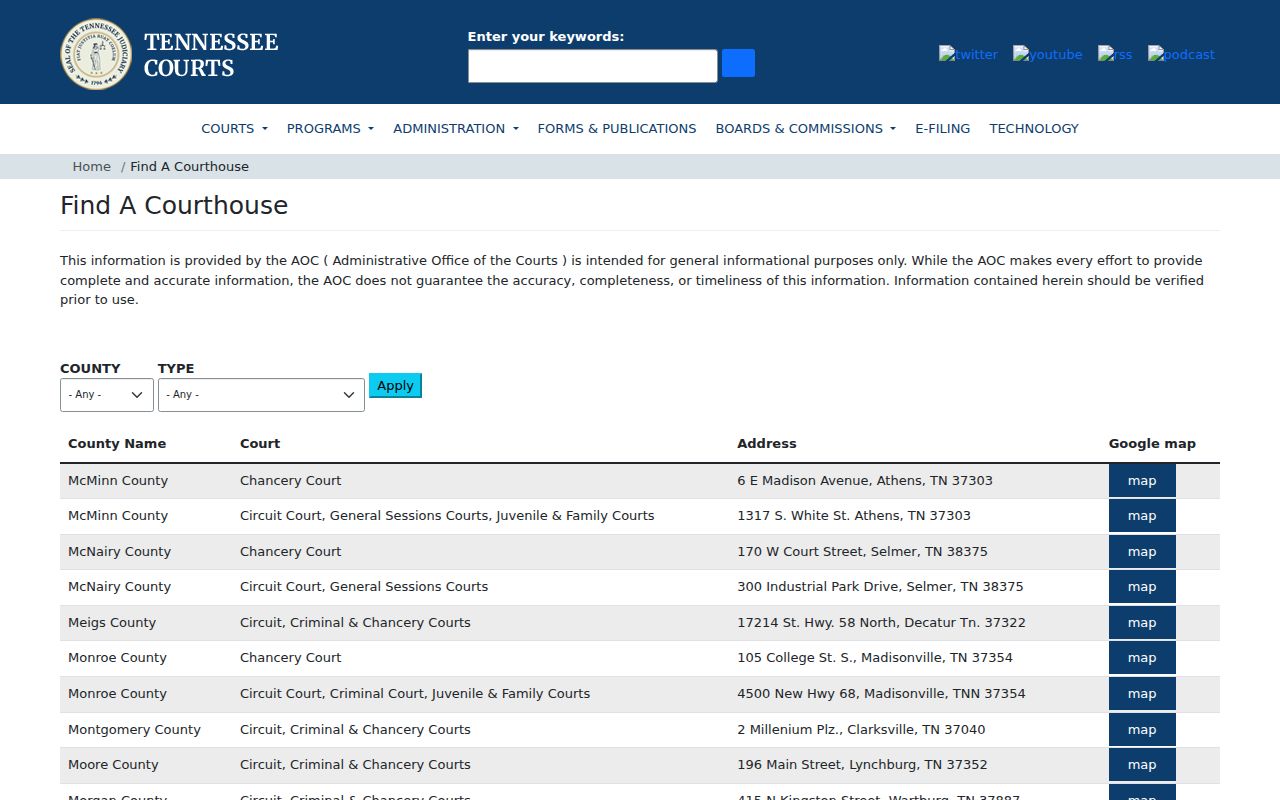
It supports direct court routing when an online name search is not available for the needed Pickett case.
Pickett Jail History and Releases
The same TACIR study described a very small historical facility with two holding rooms. It reported major constraints involving separation of detainees, medical space, exercise, food preparation, the perimeter, parking, and expansion. Those findings explain why facility identity and movement matter in Pickett release research.
They must remain in their proper period. The study is historical, while current TDOC jail summaries mark Pickett closed. It would be wrong to present the old rooms, limits, or operating pattern as current facts. It would also be wrong to pick a neighboring county merely because Clay, Fentress, and Overton appeared in the regional study. The sheriff must identify the real custodian for the date in question.
The dedicated Pickett County Jail release page treats the former local facility as a historical and records-routing subject, not an operating roster.
Find Pickett County Released Inmates
Begin with identity and the custody type. Gather the full legal name, aliases, date of birth, approximate booking date, arresting agency, case number, and any booking, TOMIS, BOP, or A-number already known. Never identify a person by a photograph alone.
- Call the Pickett sheriff and ask which facility physically held the person and how Pickett custody ended.
- If a holding jail reports community release, request its release date, time, type, authority, and released-to entry.
- Compare that entry with the Pickett court file. The court explains bond, dismissal, time served, sentence, probation, or commitment.
- For a felony state sentence, search TDOC FOIL. Read status, location, sentence, and release information together.
- Use Tennessee VINE for current status and notices. For federal or immigration custody, use the system that owns that custody.
- If an online result is absent or incomplete, request the source agency's release transaction or archived record.
A live roster answers who is confined at its update point. It is poor evidence of past custody because released and transferred people normally disappear. Pickett also has no verified official roster to use as a substitute. For a named person, the release entry plus released-to field and court authority form the best local chain.
Pickett County TDOC Release Search
TDOC Felony Offender Information Lookup, called FOIL, covers felony offenders currently or formerly in TDOC custody or supervision. That former-offender scope makes it useful after release. It is not a full Pickett arrest archive and will not capture every local misdemeanor booking.
| FOIL item | How to use it |
|---|---|
| Name or TOMIS ID | Prefer the unique state ID when known and compare all identifiers. |
| Photo and identity | Use as one match factor, never as the only proof. |
| Status | Incarcerated means custody; parole or probation signals community supervision; inactive needs release detail. |
| Location | Shows the reported placement, which can differ from the agency label. |
| Offense and sentence | Connect the result to the correct judgment and term. |
| Release information | Read the live label exactly and do not turn eligibility into actual discharge. |
Open the matching record and capture the field labels and date checked. “Parole” supports release from incarceration to conditional supervision when current. “Probation” can follow a direct probation sentence or split confinement, so it does not always prove a prison release. “Inactive” ordinarily means no active TDOC custody or supervision, but displayed release details or a TDOC record should confirm the event.
The official FOIL page shown here states its current-and-former-offender scope.
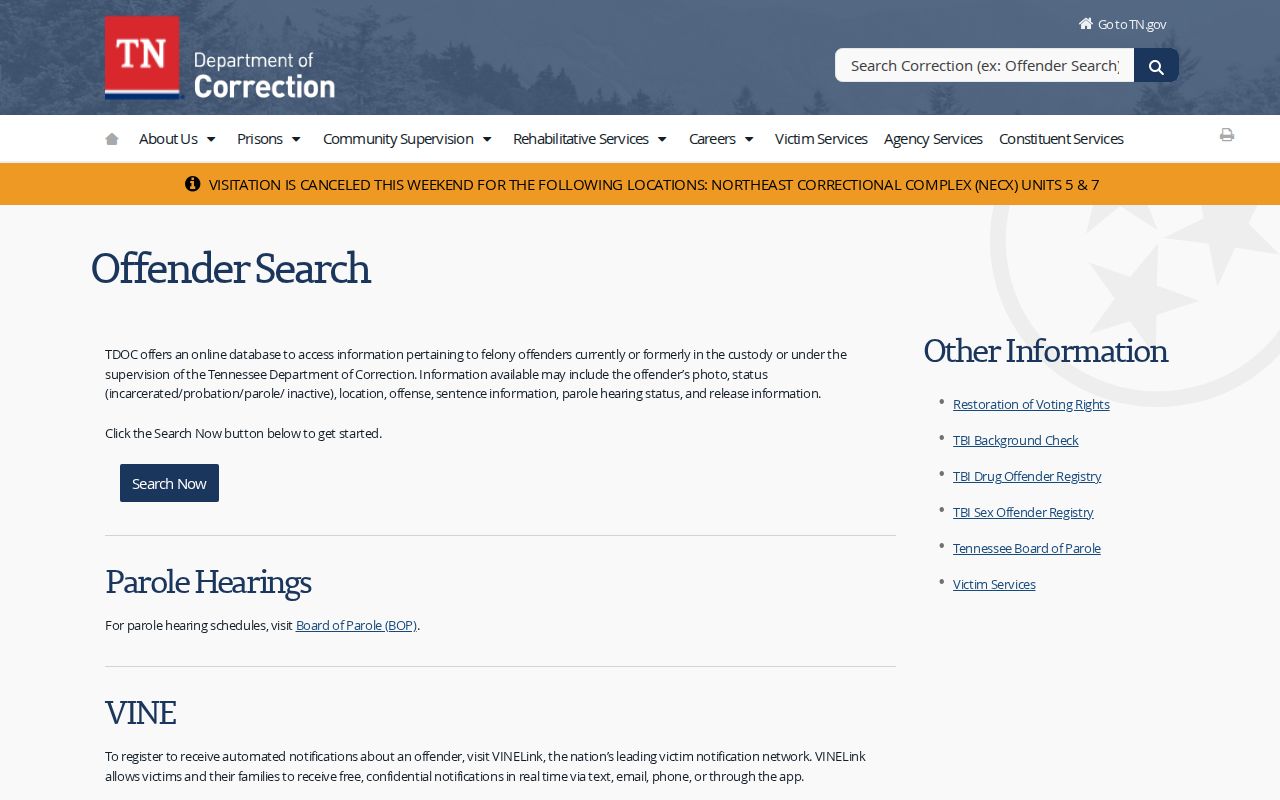
The screenshot is a portal entry point, not evidence about any named person. If FOIL lacks detail, request the release transaction or archived offender record from TDOC Records Management.
Note: A Release Eligibility Date is a possible consideration point, not proof that a Pickett County person left custody.
Pickett Release Search by Status
Each official system has a narrow role. Choose it by the custody that needs confirmation, then return to the source record for proof.
| Situation | Best public starting point | Strong confirming record |
|---|---|---|
| Local or other-county jail | Pickett sheriff and actual holding sheriff | Booking/release log plus Pickett court authority |
| State felony custody or supervision | TDOC FOIL | TDOC release transaction or archived record |
| Release notification | Tennessee VINE | Reporting agency's release entry |
| Federal sentence | BOP Inmate Locator | BOP record and federal docket |
| Federal pretrial detention | Federal docket and physical jail | USMS or holding-jail record |
| Immigration custody | ICE ODLS | Local released-to field and ICE record |
The absence of a name means little without knowing a system's scope and retention. FOIL does not cover every county booking. BOP generally covers records from 1982 forward. ICE's locator has a limited recent-release horizon, and the USMS has no comparable public detainee locator.
Pickett Release Alerts and Locators
Tennessee VINE is free and draws on participating county and state sources. Select Tennessee, choose Find an Offender, search by exact name or offender ID, and compare the source agency and identifiers. Register before the expected event when possible. A custody-status alert is useful, but it is not a certified release record and depends on the agency feed.
The VINELink entry screen is shown below. The search and notification service may allow phone, text, email, in-app, or TTY channels, with a four-digit PIN used to acknowledge automated telephone notice.
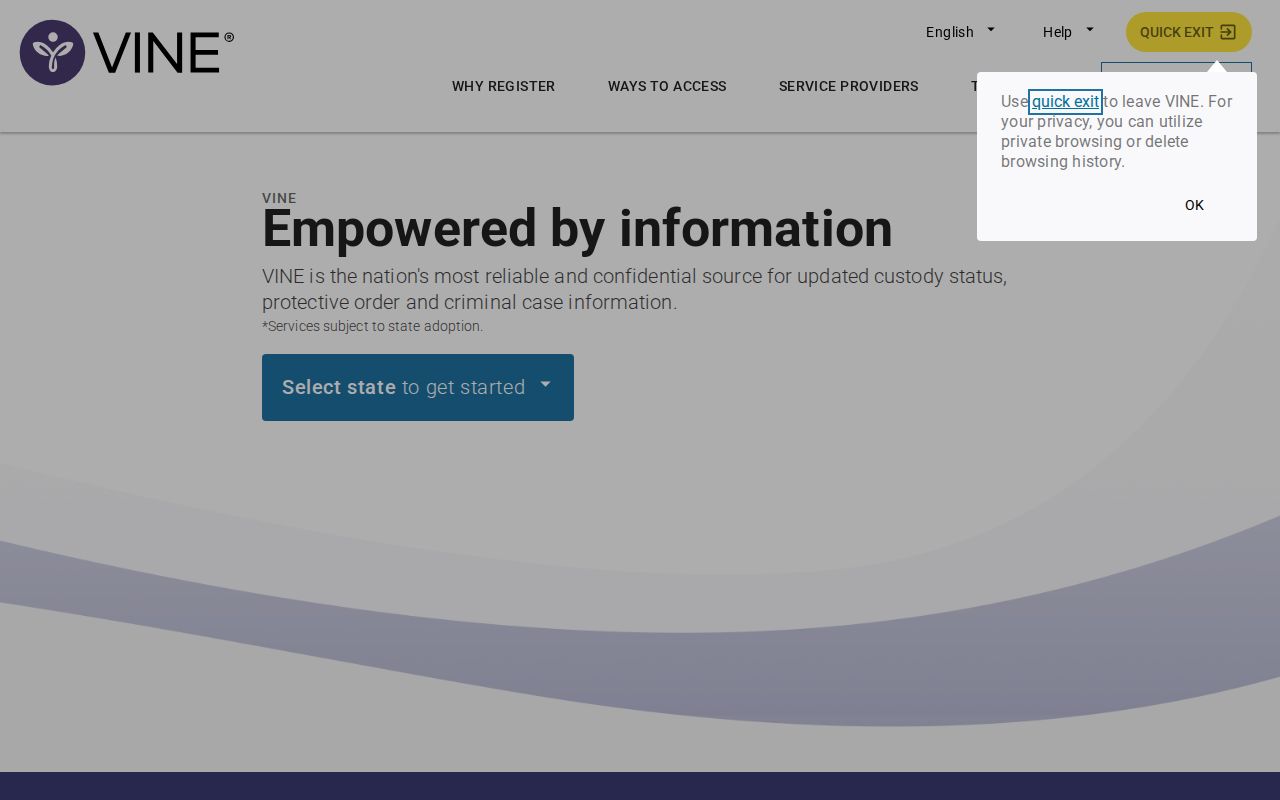
Preserve any alert, note the source agency, and confirm it with that agency. A vanished result can reflect feed or retention behavior.
For a federal sentence, the BOP Inmate Locator shows a release date and location. A past date with “RELEASED” or no institution means the person is no longer in BOP custody. It does not rule out state custody, immigration detention, or federal supervision. A federal pretrial detainee may be in a contracted jail yet absent from BOP, so use the federal docket, the physical jail, and the relevant USMS district.
Pickett Release to ICE Custody
An ICE detainer creates a second meaning of release. A person can leave local jail custody and move straight into ICE custody. The local event is an agency release, but the person has not entered the community. That is why the destination and released-to fields are essential.
ICE describes a detainer as a request for notice before release and for custody to continue up to 48 hours beyond the otherwise scheduled release. The exact record should show whether pickup occurred. Search the ICE Online Detainee Locator by A-number and country of birth, or by exact biographical data, and contact ICE when needed.
ODLS has limited visibility for recently released people. A later disappearance is not proof of freedom. Request the local jail's destination field and follow the receiving agency. The same rule applies to any detainer or transfer: one gate's exit may be another agency's intake.
Correct Pickett County Release Records
Record correction begins with the office that owns the disputed fact. For a booking or release-log error, identify the exact entry, state which field is wrong, attach an authoritative conflicting document, and ask the sheriff or physical custodian for its review process. For a judgment or disposition error, identify the case and docket entry and ask the clerk what court or administrative route applies.
State releases have a separate trail. TDOC Policy 511.03 documents release processing that can include money, property, identification, signatures, the release date, and the person or agency receiving the offender. A FOIL error should be raised with TDOC using the originating judgment or custody record. Do not assume that a portal operator can change a source court order.
Expungement and sealing are legal processes, not ordinary correction requests. Tennessee Courts lists qualifying non-conviction outcomes and narrower conviction rules under TCA § 40-32-101. Work through the originating criminal clerk. A record's lawful absence after expungement does not prove that custody never occurred or establish its release date.
Getting Home After Pickett Release
Rural transportation needs advance planning, especially when the physical jail may be outside Pickett County. UCHRA and Upper Cumberland Public Transit are genuine regional contacts. Neither source promises immediate, late-night, on-demand, or jail-door pickup.
Before an expected release, call to confirm whether the actual pickup point is served, how far ahead a reservation must be made, the fare, operating hours, and where the rider must meet the vehicle. Also verify the expected release destination with the custodian. A projected time can change due to processing, a court order, or a detainer, so transportation should not be treated as guaranteed until the holding agency confirms the event.
Note: Regional transit is a call-ahead option, not a sourced promise of transport from any jail gate.
Pickett County Release Facility
The resolved Pickett County facility map contains one local facility page: Pickett County Jail / Pickett County Sheriff's Office. It is a closed historical routing page. No separate page is assigned to a neighboring jail because no current receiving county was verified. No state prison, BOP institution, ICE center, or federal detention center was found in Pickett County.
Where should a family begin? Call the sheriff at 931-864-3210 and ask for the physical custodian and disposition on the target date. Do not infer the holding jail from geography or an old regional study.