
Pickett County Eligibility Is Not Release
Tennessee's key public term is Release Eligibility Date, often shortened to RED. RED is the point when release may legally be considered under the controlling statute and sentence calculation. It is not a promise, appointment, or confirmed exit time. Sentence expiration is also distinct from physical departure when a detainer, transfer, or other lawful custody continues.
A pretrial Pickett detainee normally has no sentence-based release date. Bond may be set, but an order setting bond does not prove payment or release. A dismissal or release order may authorize departure before staff finish processing. The physical holding jail records when the person actually leaves, while the Pickett court file explains why. Because state jail summaries list Pickett closed, ask the sheriff which agency physically holds the person before requesting a date.
A sentenced local inmate and a TDOC felony prisoner also follow different calculations. Local terms come from the judgment, jail credit, and lawful practices of the physical custodian. TDOC Sentence Management computes state felony dates. Applying prison rules to a county sentence, or assuming a county release rule governs state custody, can produce a false date.
Find a Pickett County Projected Release
Begin with the case and custody type. The Pickett County sheriff can identify the physical jail for a local arrest. The Circuit Court Clerk can supply the judgment, sentence, bond, jail-credit, commitment, probation, revocation, or amended order. For a person sentenced into the Tennessee state system, use TDOC Felony Offender Information Lookup, or FOIL. It includes current and former state offenders and may display sentence and release information.
- Confirm identity with full name, date of birth, case or booking number, and TOMIS number when applicable.
- Ask the Pickett sheriff which facility physically holds a local detainee. Do not infer the custodian from the county name.
- Obtain the judgment and sentence from the court. Note offense, offense date, sentence length, jail credit, and whether terms run together or in sequence.
- For state custody, open FOIL and read the exact release or sentence field labels. Never relabel RED as actual release.
- Ask the physical jail or TDOC for the current calculation when the public entry is missing, stale, or unclear.
- After the expected event, verify the actual release transaction and released-to field.
FOIL is not a local booking archive. An absent result does not prove that a Pickett detainee was released or never confined. For a state record that no longer displays enough detail, use the TDOC archived-record request. Ask for the computation history, actual release date and type, released-to agency, CR-1947 authorization, and CR-3626 notice if maintained.
The official FOIL entry page describes its current and former offender coverage:
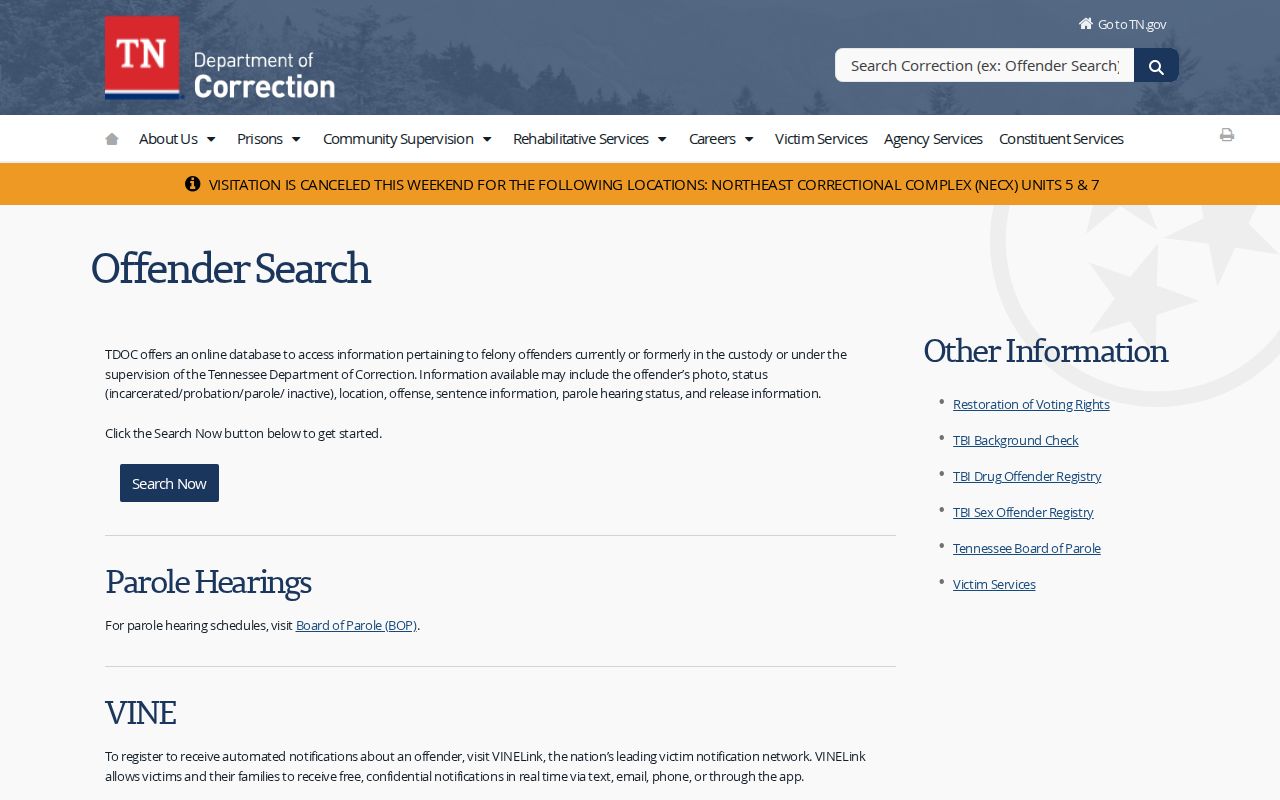
The landing page begins the lookup. The matching person's live sentence screen, with its exact labels and capture date, is needed to interpret a projected date.
Pickett County Release Calculation Chain
A sound Tennessee calculation begins with the judgment. Record the offense, offense date, felony class or range, sentence length, jail credit, and whether multiple terms are concurrent or consecutive. Concurrent terms run at the same time. Consecutive terms run one after another. A special sentencing law may override a broad rule that applies to other convictions.
Next, TDOC applies the correct part of TCA § 40-35-501. Sentence credits, statutory floors, exclusions, disciplinary forfeitures, and restored credits can affect the result. The Tennessee Board of Parole may later act when the person becomes eligible. An approved release plan and other pre-release conditions may still be required after a parole grant.
The chain can be expressed simply: judgment and jail credit → controlling statutory percentage → permitted credits and floors → parole or other release authority → approved plan and holds → actual release transaction. Every arrow represents a possible source of change. No public calculator can replace the official TDOC result.
- Release Eligibility Date
- The date when release may first be considered under the governing calculation.
- Sentence expiration
- The end point of the sentence as officially computed.
- Jail credit
- Time a court credits toward the sentence for qualifying prior confinement.
- Detainer
- A request or notice from another agency that may affect where the person goes when one custody ends.
Note: Record the screen date and every exact field label because a later sentence update can change what FOIL displays.
No Universal Pickett County 85% Rule
Tennessee does not impose one universal rule requiring every sentenced person to serve 85 percent. Section 40-35-501 varies by offense, offense date, range, and subsection. Some enumerated offenses use 85-percent or 100-percent structures. Other sentences follow different eligibility rules. Saying that every person serves “about 85%” is inaccurate and can move a projected date by months or years.
The statute also changes across date bands. For a defined group committed from July 1, 2021 through June 30, 2024, eligibility occurs after 85 percent less permitted credits, with a 70-percent floor. For specified offenses committed on or after July 1, 2024, the statute uses an undiminished 85-percent point, with credits affecting eligibility only within the limits stated by law. Those provisions do not describe every offense.
Use the conviction offense and offense date from the judgment. Then request TDOC's computation when the applicable subsection is uncertain. The statutory percentage governs eligibility, not necessarily actual community release. A person can reach RED and remain incarcerated after a denial, deferral, unapproved plan, pending charge, or detainer.
Pickett County Release Credits and Floors
The TDOC offender handbook summarizes behavior credits of four days per month during the first calendar year and six days per month afterward, along with program-credit rules. Those figures must not be subtracted from every sentence. Credits are privileges, and offense-based exclusions or statutory floors may limit their effect. The official computation decides whether a credit applies.
TDOC disciplinary policy 502.02 provides for loss of sentence credits. A forfeiture can move RED later. Escape or serious assault consequences can extend the eligibility point as far as sentence expiration in applicable cases. Completion of an approved program may affect permitted credits, while a disciplinary change can reverse part of an earlier forecast.
No Pickett-specific local good-time, weekend-release, or holiday-adjustment policy was found. A person serving a county misdemeanor or local term should obtain the judgment and ask the actual custodian's records staff how the term is calculated. TDOC prison behavior credits should never be applied by guess to that local sentence.
What Changes Pickett County Release Dates
A projected date is a point-in-time result. Changes to the sentence, earned-credit record, release authority, or destination can move the forecast or change what happens on that day. The relevant office depends on the cause.
| Factor | Possible effect | Best source |
|---|---|---|
| Corrected judgment or jail credit | Changes the base term or credit already served | Pickett court order and TDOC calculation |
| Consecutive or concurrent case update | Adds time in sequence or aligns terms | Judgments and Sentence Management |
| Credit earned, lost, or restored | May move RED within statutory limits | TDOC computation and disciplinary record |
| Parole decision | Can grant, deny, defer, rescind, or revoke release authority | Board final decision, not a hearing calendar |
| Release-plan approval | A grant may remain pending until approval | TDOC and institutional parole officer |
| Pending charge or detainer | Can redirect the person into another agency's custody | Release transaction and released-to field |
| New court order | May alter custody or the sentence calculation | Filed court order |
A transfer is not community release. A local jail can end its custody by sending someone to another county, TDOC, federal authorities, or ICE. Likewise, a TDOC release to a detainer may begin a new confinement. Always request the destination agency and follow the record to the receiver.
Confirm Pickett County Actual Release
After a projected day arrives, check current status and obtain the actual transaction. For a local case, ask the Pickett sheriff to identify the physical jail, then request release date and time, release type, authority, and released-to destination from that custodian. Compare those fields with the Pickett judgment or bond order. The court explains authority; the jail confirms the physical exit.
For TDOC, current parole or inactive status plus displayed release information is a useful public signal. Stronger proof is the release authorization or archived transaction showing actual date, released by, released to, pending charges, detainers, and signatures. A parole grant alone remains insufficient because plan approval and processing can delay departure.
A narrow archived request should ask for the offender-management release transaction, sentence-computation history, actual release date and type, sentence-expiration date, RED, and any CR-1947 or CR-3626 document maintained for the event. Include the full name, TOMIS number, date of birth, and enough detail to identify the record. TDOC asks for requester contact information and a reason. It may assess charges after an archive search and says not to send payment at the outset.
Local records require a different request. Ask the physical jail for the existing release or booking-disposition entry, not a newly created forecast. Request the booking number, release time, release code, authority, destination, transfer detail, and detainer notation if maintained. The Pickett clerk can supply the filed sentence and jail-credit record, but may not have the precise gate time. When the two timestamps differ, the order may have authorized release before jail processing finished.
The Pickett County VINELink inmate search can send a status-change alert when a participating agency updates its feed. Register before the expected event and preserve the notice. The alert is not a certified release record, may lag, and may describe a transfer rather than freedom. Confirm it with the source agency.
Note: When official records conflict, use the newest source record and ask its custodian to review the exact disputed field.