
Pickett 72-Hour Feed Is Absent
No official Pickett County page publishes a rolling 72-hour release view. Research also found no release archive, supported publication schedule, photo field, retention promise, or sheriff mobile app. The Tennessee Department of Correction jail reports list Pickett as closed, while the official county sources provide office contacts instead of a live custody database.
That absence sets the workflow. Contact Sheriff Dana Dowdy's Pickett County office to learn which jail received the person and what happened to Pickett custody. Then request the three-day release log from the physical custodian. Pickett records may show arrest, transport, or commitment activity, but another jail's staff record the actual gate event when that jail supplied the bed.
Set Pickett's Three-Day Release Range
A sound request gives exact start and end timestamps in Central Time. Name all three calendar dates rather than asking vaguely for “the weekend” or “the last few days.” For example, request existing release transactions from 12:00 a.m. on the first date through 11:59 p.m. on the third. A rolling 72-hour interval needs its own precise endpoints.
Those two methods are not always equal. A request made late Monday for the previous 72 hours starts late Friday. Three named calendar days might cover Saturday through Monday in full. Pick the span tied to the event being checked, include the approximate booking date, and ask whether the timestamps use local time.
No Pickett County online retention term was found. A record is not guaranteed to remain visible for three days because no such public view exists. The public-record route concerns whatever existing booking, disposition, and release records the responsible agency retains.
Check Pickett County Three-Day Releases
Identity matching matters more across a wider window. Similar names can appear, one person may have more than one custody episode, and an arrest before the range may end inside it. Collect the date of birth, booking number, case number, and arresting agency before contacting officials.
- Write down the exact three-day interval, including Central Time endpoints and the person's known identifiers.
- Call the Pickett County Sheriff's Office at 931-864-3210 to identify the physical holding agency and Pickett disposition.
- Ask the physical custodian for its existing release or booking/disposition log for the stated range.
- Request fields that distinguish community release from transfer, TDOC commitment, or detainer delivery.
- Compare each match by booking number, date of birth, case number, and booking date rather than name alone.
- Obtain the Pickett court order or disposition that explains the legal basis, then follow any receiving agency.
If only today's events matter, the Pickett County 24-hour release page gives the narrower request format. Keep the wider interval when a booking or release may have crossed a date boundary.
Note: A clerk's order may precede physical processing, so match the legal event to the custodian's later gate timestamp rather than expecting identical times.
Pickett 72-Hour Release Record Fields
There are no published Pickett County feed columns to reproduce. These are supported request targets, and they may be stored across several records. Ask for existing fields only. The agency need not create a special table, calculate an answer, or disclose material protected by an applicable exemption.
| Field to request | Use across three days |
|---|---|
| Full name and identifiers | Separates people with similar names and ties the result to the correct custody episode. |
| Booking number | Provides the strongest local key when the same person has multiple entries. |
| Booking date and time | Shows whether custody began before or within the chosen interval. |
| Release date and time | Places the agency's exit transaction within the exact three-day range. |
| Release or disposition code | Helps distinguish bond, order, time served, sentence end, transfer, or another maintained outcome. |
| Release authority | Connects the physical event with an order or other legal basis. |
| Released to or destination | Shows whether custody truly ended or continued under another agency. |
A booking photo is not release proof, and no Pickett release-photo field is supported. A date is also incomplete without the disposition and destination. The best record states when one agency ended custody, why, and who or what agency received the person.
Pickett Weekend Release Timing
No Pickett County weekend, holiday, release-hour, or local good-time policy was located. Do not assume an order entered Friday led to departure that day. Staff may still need to confirm identity and authority, resolve a detainer, return property, arrange transport, or identify another custodian. The release log provides the recorded physical time.
A three-day span helps with date boundaries, not with proof by itself. Saturday through Monday can capture a late weekend transaction and a Monday event in one request. Yet the custodian may organize records by booking number or disposition instead of maintaining a public daily list. Give enough identity data to allow a record search.
If an office says the person is no longer there, ask the follow-up question. Was the person released to the community, sent to another county, committed to TDOC, delivered on a detainer, or otherwise removed? “Not here” describes location. It does not identify the legal or physical outcome.
Closed Status Guides Pickett Releases
The current closed designation carries more weight than old and commercial pages that continue to present a generic Pickett County jail search. The official state report source shown below documents the administrative context. It does not say that Pickett County makes no arrests, owns no historical records, or can never hold someone briefly.
Consult the official TDOC jail-summary page associated with this capture.
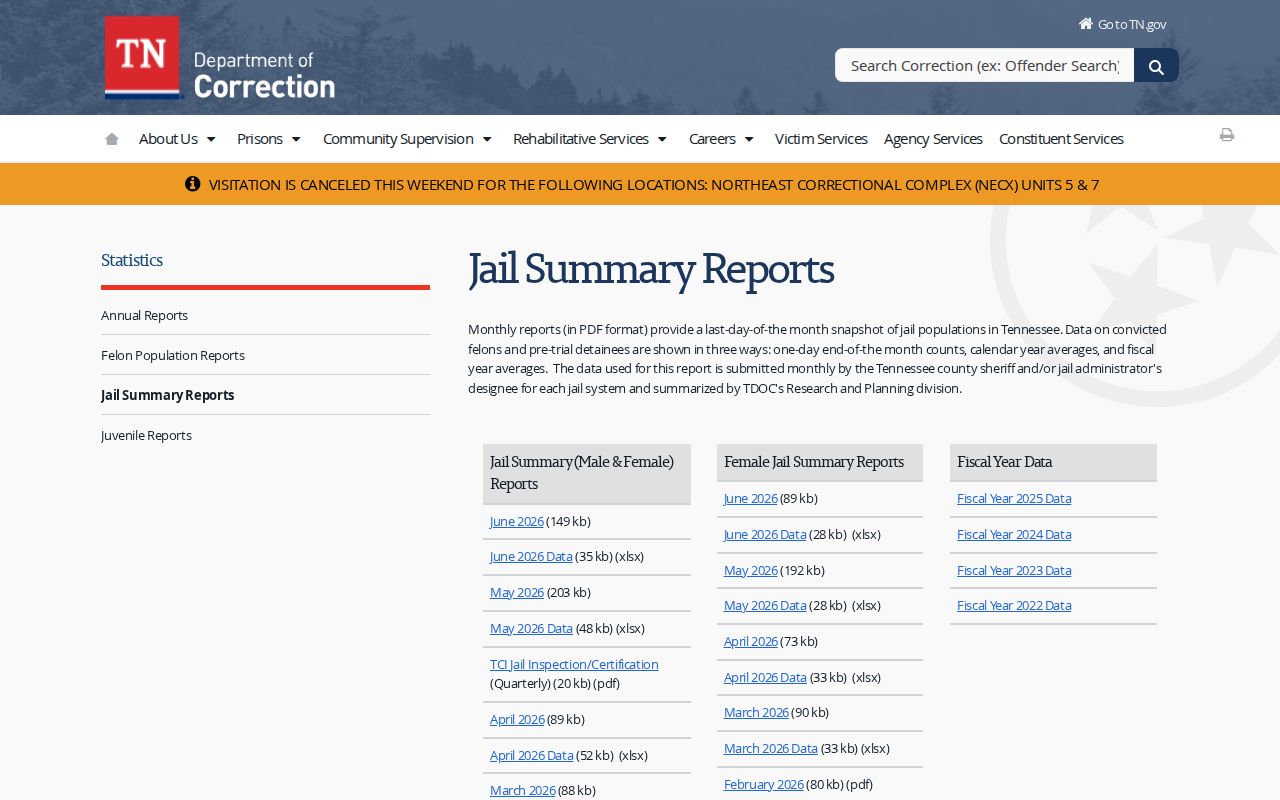
The practical result is a two-office chain. The sheriff routes the custody question to the agency that held the person. The Pickett court clerk supplies the bond, judgment, sentence, dismissal, probation, revocation, or amended order that explains why custody changed.
This county-specific workflow is the Section 19 roster angle: use the actual custodian's release log plus the Pickett court file. Do not relabel a current roster, and do not promise an online retention period that official sources never published.
Request Pickett Three-Day Release Logs
A useful request reads: “I request the existing release or booking/disposition log for persons whose custody ended between [exact start] and [exact end], Central Time. Please include fields already maintained that distinguish release to community, bond, time served, court order, transfer to another jail, commitment to TDOC, detainer delivery, or other disposition, with destination agency where maintained.”
Add: “If no compiled log exists, please identify the record series that records individual release transactions.” This language asks for existing material rather than a new report. It also guards against treating a list of movements as a list of people who reached the community.
The Tennessee Public Records Act gives Tennessee citizens access to covered records subject to exemptions. Inspection generally carries no fee. Copies may carry reasonable charges. If prompt access is impracticable, the custodian must within seven business days produce, deny with a legal basis, or give a reasonable production time.
No Pickett-specific request form, office hours, or fee schedule was found. Confirm delivery method and costs before ordering copies. A one-person request often reduces ambiguity, review, and expense when the goal is to verify one release rather than survey a full interval.
Trace Pickett Releases Beyond Jail
A receiving agency changes the next search. A transfer to another county belongs in that sheriff's custody and release records. A felony commitment belongs in TDOC FOIL, which covers current and former state offenders and may show status, location, sentence, and release information. “Incarcerated” means custody remains. “Parole” and “probation” are community supervision statuses. “Inactive” should be paired with the release information or an archived TDOC record.
VINE can help with a current check and alerts if registration occurred before the status change, but it is a notification service rather than a certified archive. A missing result proves little. BOP is the source for a federal sentence. A U.S. Marshals Service pretrial detainee requires the federal docket and physical jail. ICE custody requires the ICE locator and the prior jail's destination field.
| Outcome | Next authoritative source |
|---|---|
| Community release from an outside county jail | That jail's release transaction plus the Pickett court file |
| Transfer to another county | Receiving sheriff's current custody and later release records |
| Commitment to Tennessee prison | TDOC FOIL and, when needed, TDOC archived records |
| Federal sentence or pretrial custody | BOP locator, or federal docket, USMS, and holding jail |
| Delivery on an ICE detainer | Local released-to field followed by official ICE custody channels |
Preserve booking numbers, case numbers, and agency names as the search moves. A single name is weak across three days. The records chain becomes reliable when identity, event time, legal authority, and destination agree.
Note: A status alert or search result is a lead; the agency release transaction remains the stronger record of when and where custody changed.