
Pickett County Parole and Probation
Parole and probation both place a person in the community under rules, but they begin in different ways. The Tennessee Board of Parole decides whether an eligible state prisoner should receive parole. TDOC Community Supervision then administers parole. A judge orders probation, either as a direct community sentence or after a period of split confinement. Split confinement means part of a sentence is served in custody and the rest under probation.
The distinction matters when verifying a Pickett County release. Current parole status supports that a state prisoner has left incarceration for conditional supervision, but only after TDOC has processed release. Probation may follow a jail stay, yet it may also begin without any prison release. The Pickett judgment and probation order establish which path applies. Neither label erases the sentence or the underlying court record.
| Point | Parole | Probation |
|---|---|---|
| Who authorizes it | Tennessee Board of Parole | Sentencing court |
| Custody history | Follows incarceration on the state sentence | May be direct or follow split confinement |
| Public starting point | FOIL status and release information | FOIL status plus the court order |
| Proof of physical release | Current status joined to the TDOC release transaction | Actual jail record when confinement occurred |
- Parole
- Conditional release from incarceration before the sentence fully expires.
- Probation
- Court-ordered supervision in the community, with or without an earlier jail stay.
- Discharge
- The formal end of active supervision, not merely a move between officers.
- Absconder
- A person alleged to have stopped reporting or whose location is unknown to supervision staff.
Verify Pickett County Supervision Status
The official public starting point is the TDOC Felony Offender Information Lookup, commonly called FOIL. It covers people currently or formerly in TDOC custody or supervision. That scope makes it useful after a state-prison release. It is not a complete archive of every Pickett arrest or misdemeanor case, so a missing result does not prove that no local custody or probation existed.
- Gather the full legal name, aliases, date of birth, and TOMIS number if known.
- Open FOIL and use the TOMIS number when possible. Name-only results require extra identity checks.
- Compare the photo and identifiers, then read status, location, offense, sentence, parole-hearing, and release fields together.
- If status says parole or probation, contact the listed supervision route and compare it with the Pickett court judgment.
- For a past release, request the TDOC release transaction or archived record when FOIL lacks the actual date and released-to field.
FOIL terms need a careful reading. “Incarcerated” means custody remains. “Parole” identifies conditional community supervision when current. “Probation” identifies a court-based community status. “Inactive” ordinarily means no active TDOC custody or supervision, but it should be paired with release information or an archived discharge record. The full Pickett County released inmate search path explains how local jail and court records fill the gaps that FOIL cannot cover.
The official FOIL page shows its current and former offender scope:
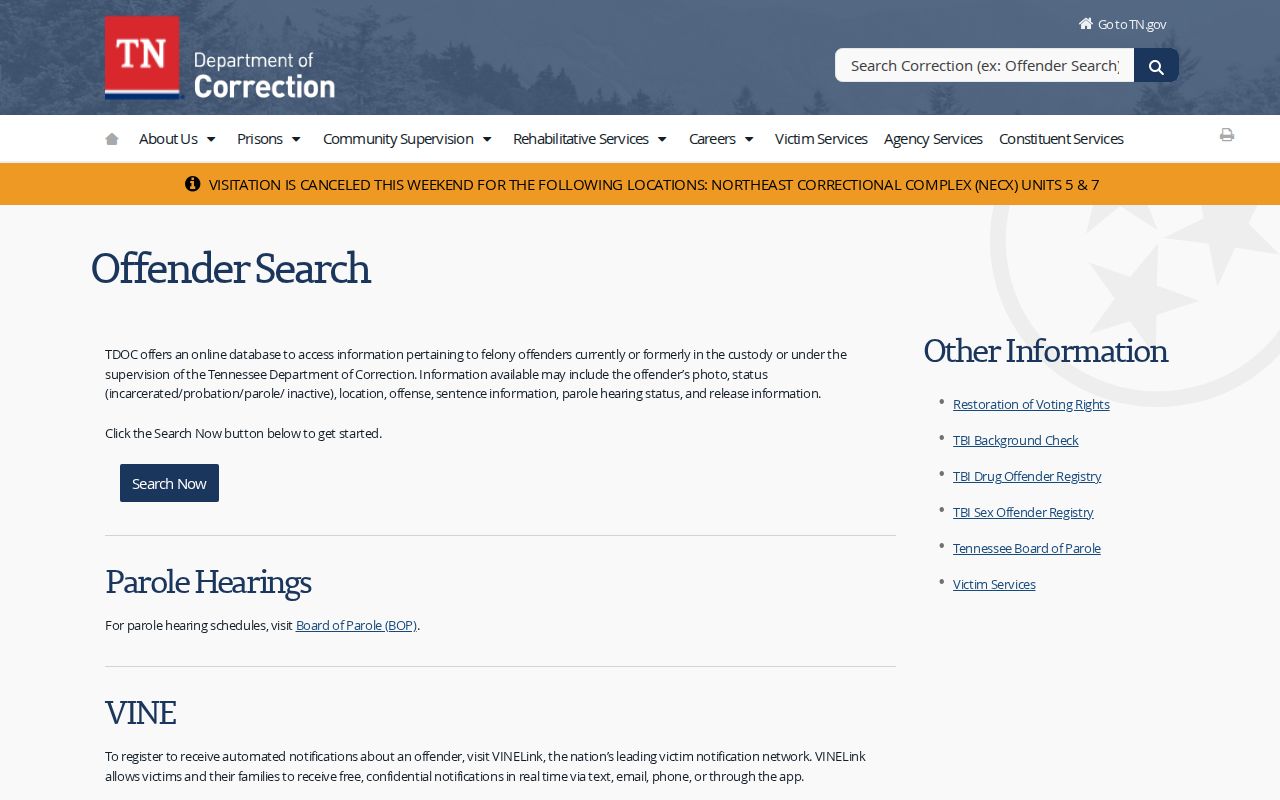
This screen is the entry point, not proof of a specific person's release. Open the matching record and preserve the exact status and date labels shown.
When a former state offender's public entry is too brief, ask TDOC Records Management for the archived release transaction and supervision history. The research identifies its mailing address as Rachel Jackson Building, Second Floor, 320 Sixth Avenue North, Nashville, TN 37243-0465, with questions directed to 615-253-8079. TDOC may assess archive charges and instructs requesters not to send payment before receiving a quote. A focused request should name the person, TOMIS number, date of birth, event, and exact records sought.
Note: A photograph can help separate similar names, but it cannot establish identity, release, or supervision status on its own.
Pickett County Supervision Uses District 31
Pickett County is routed to TDOC District 31 rather than a documented supervision storefront in the county. The TDOC field-office directory identifies the Cookeville office. Its staff can confirm office routing and the current reporting contact, though privacy and operational rules may limit details about an individual.
851 South Willow Avenue, Suite 202
Cookeville, TN 38501
Phone: 931-526-7165
Fax: 931-528-3267
Hours: confirm with the office
A person placed on felony probation or released from split confinement must follow the reporting instructions in the order and TDOC materials. TDOC states that probationers must report within 48 hours of placement on probation or release from split confinement. That deadline does not supply a release date. The court order and physical custodian's release log still control the custody event.
Call District 31 with the TOMIS number when available. Ask whether the office is the right routing point, not for information the office cannot disclose. For probation tied to a Pickett case, also obtain the judgment, probation order, and any later revocation or amended order from the Circuit Court Clerk.
Pickett County Parole Grant Limits
Eligibility, a scheduled hearing, a Board decision, and physical release are four separate events. A Release Eligibility Date marks when parole may be considered under the applicable sentence law. A hearing schedule only shows a planned proceeding. The Board can grant, deny, defer, revoke, rescind, or take another authorized action based on the hearing type. None of those calendar entries is a gate transaction.
The Board's hearing information says schedules are updated weekly and remain subject to change. No separate public decisions database was located. FOIL may show hearing status, while Board Operations processes final dispositions. For firm proof, obtain the final decision and TDOC release authorization, then check for a current parole status.
The Board's official hearing page illustrates the difference between a schedule and a decision:
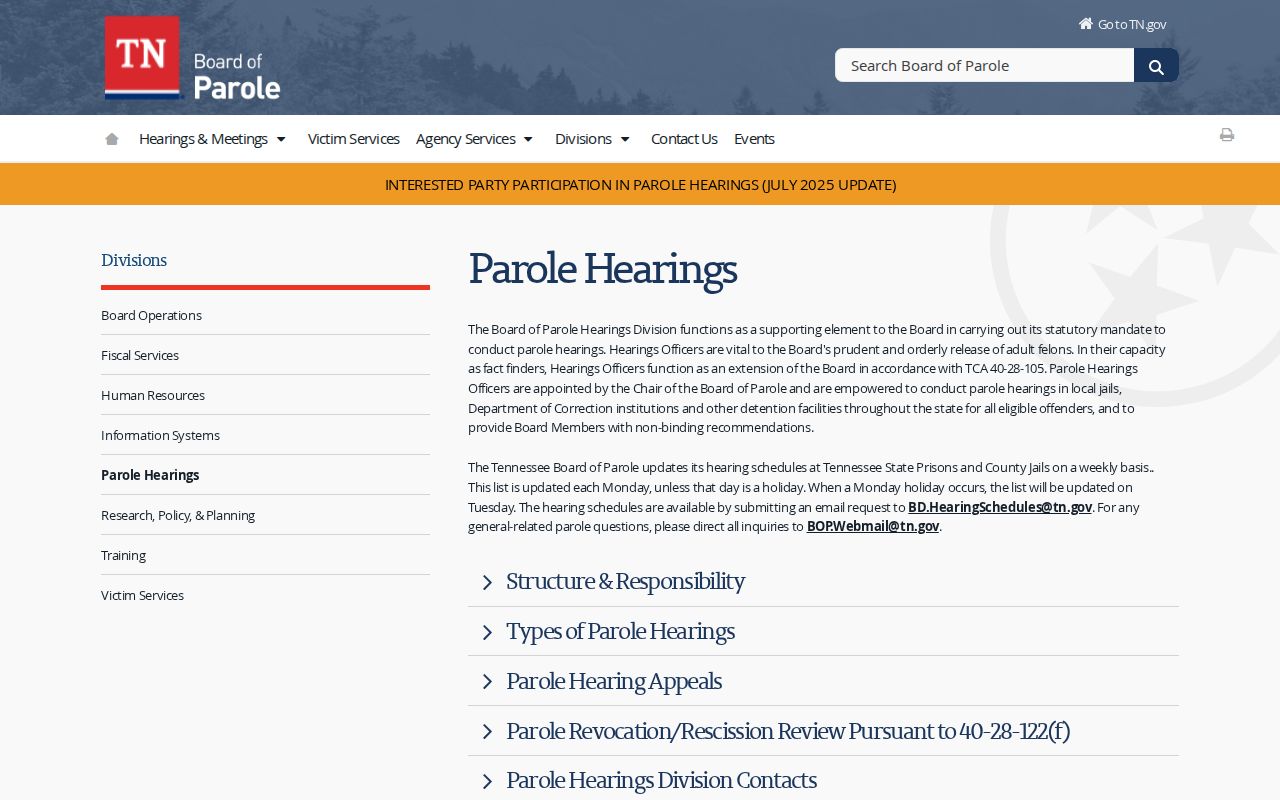
The page helps locate process information, but a person's absence or presence on a schedule never proves release.
Pickett County Release Supervision Categories
Tennessee law creates several community statuses beyond ordinary parole and probation. Determinate release is a special probation category for certain felony terms of at least one year and no more than two years. It generally follows the percentage and notice process in TCA § 40-35-501. The exact judgment and TDOC computation control.
Mandatory reentry supervision under TCA § 40-35-506 applies in defined situations involving qualifying felony offenses committed on or after July 1, 2021. Community supervision for life under TCA § 39-13-524 applies only to specified offenses. These categories explain why a person may have left a prison yet remain visible in a TDOC community-supervision context. They do not prove that all Pickett releases carry state supervision.
A direct probation sentence must not be called a state-prison release. Likewise, a person serving a local sentence may be supervised after split confinement without ever entering a TDOC prison. Ask the clerk for the judgment and sentence. Then use the custodian's release record to establish whether confinement actually preceded supervision.
Note: Sentence labels can overlap in a record, so match the offense, case, status date, and supervising authority before drawing a conclusion.
Pickett County Violations and Discharge
Conditions can include reporting, approved residence, payment terms, travel limits, treatment, or other requirements set by the court, Board, and TDOC. The exact conditions belong to the individual's order and supervision documents. A suspected violation may lead to an administrative response, warrant, revocation process, or renewed custody, but it does not establish guilt by itself.
An absconder label generally means supervision staff allege that the person stopped reporting or cannot be located. It is not the same as discharge. Verify a public FOIL status and contact District 31 for the proper route. If a court warrant or revocation is at issue, the Pickett court docket and order are the legal sources. VINELink can provide custody-change alerts when a participating agency reports a later detention, but it does not certify a probation violation.
Supervision ends through a formal discharge, sentence expiration, court order, or another legally authorized event. Ask for the discharge record if current FOIL fields are abbreviated. An old parole or probation reference should not be treated as current without a date and present status.
Correct Pickett County Release Records
A correction request must go to the office that owns the disputed fact. The Pickett sheriff or the actual holding jail owns its booking and release log. The Circuit Court Clerk owns the docket, judgment, and filed orders. TDOC owns FOIL data, sentence computation, supervision status, and state release transactions. Sending the same claim to every office can slow the review because no single office can rewrite another agency's record.
Identify the exact entry, state which field is wrong, and attach the official record that conflicts with it. A clerk cannot alter a judge's order informally. A sheriff can explain its process for reviewing a release entry. For state data, cite the judgment or custody record and ask TDOC to review the relevant field. Expungement is a separate legal process and should not be framed as simple correction.
TDOC Policy 511.03 also makes actual release distinct from a forecast. Its CR-1947 authorization records who completed release, whom the person was released to, and the processing of money, property, identification, GPS, and signatures. Those details may resolve disputes that a brief public status cannot. Request the release transaction or archived file by name, TOMIS number, and event date.