
No Pickett 24-Hour Release Feed
Pickett County does not have a verified official page listing people released today. The authoritative sweep found no sheriff-operated inmate search, booking-photo stream, rolling release archive, or mobile app. Current Tennessee jail summary reports identify Pickett as closed. That state designation controls over commercial directory pages that still describe a live jail database.
This finding does not mean Pickett County makes no arrests or holds no older records. It means an online list cannot be presented as though it exists. The Pickett County Sheriff's Office remains the starting point because it can identify the physical custodian, explain whether Pickett custody ended, and route a records request. If another county jail held the person, that jail owns the gate event and release log.
Why Pickett Release Records Need Routing
The lack of a Pickett County recent-release feed is a records issue, not a reason to rename a current-custody list. Sheriff Dana Dowdy's office is the local routing contact, not an online feed operator. A roster answers who was confined at its update point. A release log records an exit transaction. Those are different records, and a transfer can remove a person from one roster while custody continues elsewhere.
The official state jail-report page gives the best published evidence for the closed designation. Review the TDOC jail summary source shown below before relying on an undated jail directory.
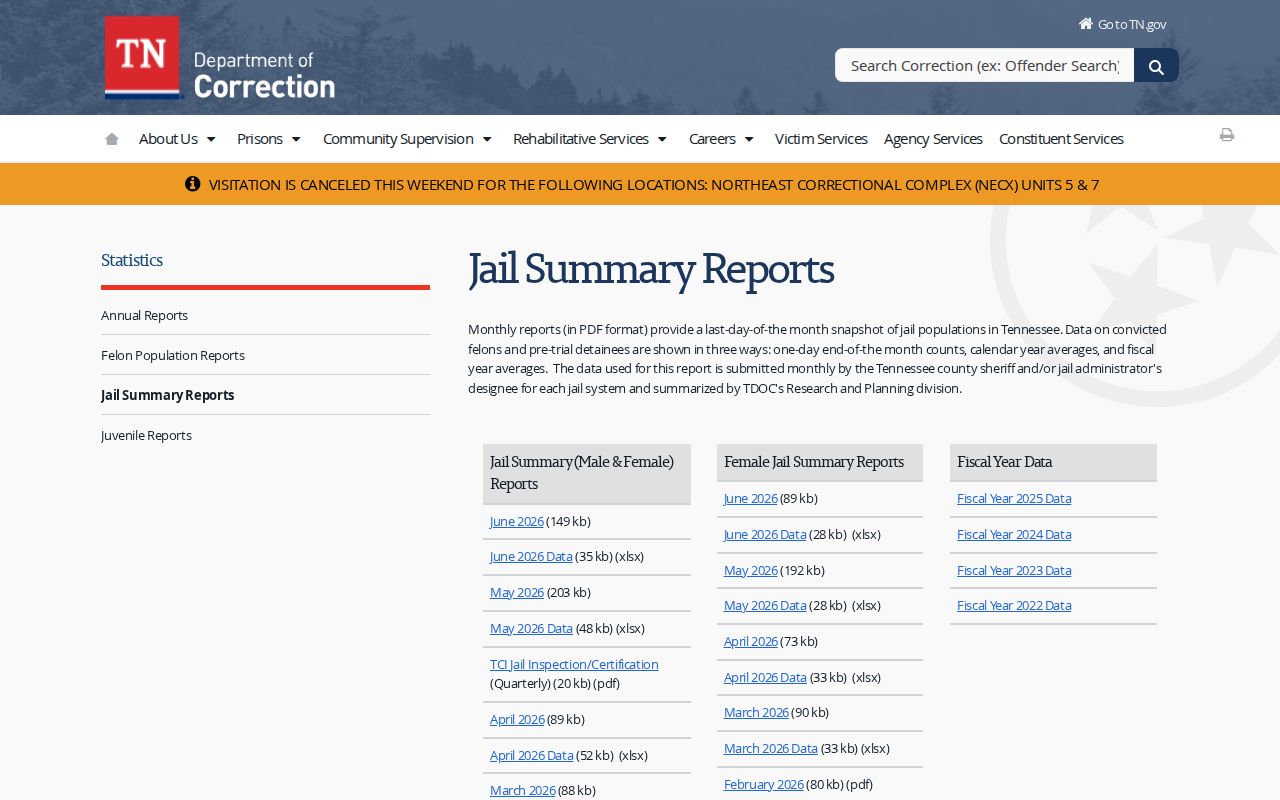
The image supports the fallback method: establish which agency held the person, then ask that custodian for the precise Pickett County release transaction. It does not serve as a list of current or recently released people.
Pickett County may still hold arrest, transport, commitment, or court-linked records even when another agency supplied the bed. Ask the sheriff both questions: “What happened to Pickett custody?” and “Which agency physically held this person?” The answers determine where the 24-hour date-range request belongs.
Check Pickett County Daily Releases
A same-day inquiry works best when the interval is exact. “Today” can mean a calendar day, the period since midnight, or the preceding rolling day. An arrest near midnight may end after the date changes, so include both the booking date and the requested release interval. Use Central Time and write the endpoints.
- Gather the full legal name, date of birth, aliases, booking date, case number, and booking number when known.
- Contact the Pickett County Sheriff's Office at 931-864-3210 and ask which agency physically held the person.
- Ask the actual custodian for existing release transactions from 12:00 a.m. through 11:59 p.m. Central Time on the chosen date, or give exact rolling start and end times.
- Request the release type, authority, destination, and any transfer or detainer notation already maintained with each entry.
- Match the result to the Pickett court docket or order. Follow a named receiving agency if the event was a transfer.
A request for one person is often easier to match than a broad daily log. For a broad list, ask for the existing record series rather than requiring staff to create a new report. Tennessee public-record law does not force an office to build a list it does not keep.
For a named-person search that reaches beyond one date, use the full release path on the Pickett County released-inmates page. That path separates local bookings from TDOC, federal, and immigration custody.
Note: Save the response date and custodian name because a later correction or transfer update can change how the event is understood.
Pickett 24-Hour Release Record Fields
Because Pickett County publishes no official feed, no set display fields can be promised. The table lists targeted fields supported by the research as useful request items. They may sit in a booking record, jail log, release transaction, or transfer record rather than one screen. Disclosure also depends on what the custodian keeps and what law permits.
| Requested field | What it can establish |
|---|---|
| Name and identifiers | Whether the entry belongs to the right person rather than someone with a similar name. |
| Booking number and time | The specific custody episode and whether it began before the release date. |
| Release date and time | When that agency recorded custody ending, including events just after midnight. |
| Disposition or release type | Whether the event involved bond, court order, time served, sentence completion, or another maintained code. |
| Release authority | The order, sentence event, or other basis used by the custodian. |
| Released to or destination | Whether the person entered the community or moved to another jail, TDOC, or a detaining agency. |
| Detainer or transfer notation | Why leaving one agency may still mean continued custody. |
These are request targets, not claims about a Pickett County online form. The record should answer when the agency ended custody, why it ended, and to whom the person was released. A date without the destination is incomplete proof.
Define the Pickett 24-Hour Window
A calendar request can read: “I request the existing release or booking/disposition log for persons whose custody ended from 12:00 a.m. through 11:59 p.m. Central Time on [date].” A rolling request should replace those points with exact dates and times. State that the request seeks existing fields distinguishing community release, bond, time served, court order, transfer, TDOC commitment, and detainer delivery.
If no compiled Pickett County log exists, ask staff to identify the record series that records individual release transactions. This phrasing respects the boundary between obtaining a record and asking an office to make a new one. A broad log can also require redaction or labor, so ask for a cost estimate before copies are produced.
Under the Tennessee Public Records Act, a Tennessee citizen may inspect covered records unless an exemption applies. If prompt access is impracticable, the custodian has seven business days to produce the record, deny the request in writing with the legal basis, or state a reasonable production time. That response framework is not a promise of same-day data.
Short Pickett Releases Evade Snapshots
A historical regional-jail study shows why a current roster is weak evidence for a prior release. The study counted 704 Pickett admissions from December 2008 through December 2009. Forty-five percent ended in under one day, and the reported average stay was 6.1 days. Those facts are historical and cannot be applied as current release rates.
The sound lesson is narrower. Brief bookings can begin and end between two roster checks. Someone may never appear on a later custody snapshot even though a booking and release record exists. A date-specific request can find that transaction, while the court file can explain the bond, dismissal, sentence credit, or order behind it.
Do not infer the outcome from duration. A short stay might end in community release, but it might also end through movement to another custodian. Ask for the release or disposition code and destination on every matching entry.
Travel After a Pickett Release
Upper Cumberland Public Transit is a real regional transportation contact, but no source promises jail-door pickup or instant service after a Pickett County release. The lack of a known current holding jail makes advance confirmation even more important. A family should first learn the actual facility, expected exit point, and whether the event is community release.
Check the UCHRA service locator and Upper Cumberland Public Transit, then confirm Pickett coverage, reservation lead time, pickup point, fare, and operating hours directly. Do not schedule a ride from an eligibility date, court expectation, or word that someone is “not here.” Wait for the custodian to confirm the release transaction and exit location.
If the release occurred from another county, that facility may be far from Byrdstown. The actual custodian can provide the correct public pickup area and current local rules. Transportation planning should never be based on the historical Pickett jail location alone.
Note: Regional transit is a call-ahead option, not proof that transport will be available at the time or place of release.
Verify Each Pickett Release Path
A county release, state discharge, and federal release use different records. For a Pickett arrest, the physical holding jail supplies the gate transaction and the Pickett clerk supplies legal authority. For a state felony sentence, the Tennessee Department of Correction FOIL service can show a current or former offender's status and release information. “Parole” or “probation” indicates community supervision, while “inactive” should be read with the actual release fields or archived record.
VINE is useful for a current check and future status alert. It is not a certified historical register, and a vanished result can reflect feed or retention behavior. A federal sentence belongs in the BOP locator. A federal pretrial detainee requires the federal docket, U.S. Marshals Service, and holding jail because no public USMS locator was found. ICE custody requires its detainee locator and the local released-to field.
- Community release
- The person left custody rather than moving directly to another custodial agency.
- Transfer
- One jail's control ended, but another jail or prison received the person.
- Detainer
- A request or hold connected to another agency that can change the destination at release.
- Discharge
- The end of the relevant custody or supervision status, confirmed by the responsible agency's record.
The court record and custodian log should agree in sequence even if their timestamps differ. The court may authorize release before staff finish identity checks, property return, transport, or other processing. The exact gate time comes from the custodian, not the docket alone.